
| 일 | 월 | 화 | 수 | 목 | 금 | 토 |
|---|---|---|---|---|---|---|
| 1 | 2 | 3 | 4 | 5 | 6 | |
| 7 | 8 | 9 | 10 | 11 | 12 | 13 |
| 14 | 15 | 16 | 17 | 18 | 19 | 20 |
| 21 | 22 | 23 | 24 | 25 | 26 | 27 |
| 28 | 29 | 30 | 31 |
- Depth-First Search
- CPP
- unordered_map
- 메모이제이션
- graph
- 이진탐색
- 비트 연산
- bitwise operation
- linked list
- 알고리즘
- bit manipulation
- union-find
- 배열
- Array
- algorithm
- hash table
- C++
- 깊이 우선 탐색
- binary
- DFS
- Sorting
- Interval
- 탐욕알고리즘
- binary search
- Sort
- LeetCode
- 비트 조작
- 동적계획법
- Greedy
- dynamic programming
- Today
- Total
공대생 공부노트(Notes for Engineering Studies)
[ leetcode 문제풀이 ] Course Schedule 본문
[ leetcode 문제풀이 ] Course Schedule
301동 노숙자 2022. 2. 7. 19:34https://leetcode.com/problems/course-schedule/
Course Schedule - LeetCode
Level up your coding skills and quickly land a job. This is the best place to expand your knowledge and get prepared for your next interview.
leetcode.com
(Course Schedule 문제는 위 링크에서 풀어보실 수 있습니다.)
< Course Schedule 문제 설명 >
Course Schedule 문제는 다음과 같다.
There are a total of numCourses courses you have to take, labeled from 0 to numCourses - 1. You are given an array prerequisites where prerequisites[i] = [ai, bi] indicates that you must take course bi first if you want to take course ai.
For example, the pair [0, 1], indicates that to take course 0 you have to first take course 1.
Return true if you can finish all courses. Otherwise, return false.
수강해야하는 numCourses개의 강좌가 0에서 numCourses - 1로 이름 붙여져 있다. prerequisites[i] = [ai, bi] : ai 강좌를 들으려 한다면 반드시 bi 강좌를 들어야 함을 나타내는 prerequisites 배열이 주어진다. (예시 생략)
너가 모든 강좌를 다 들을 수 있다면 true를 리턴하고, 그렇지 않으면 false를 리턴하여라.
다음 두 가지 출력 예시가 주어졌다.
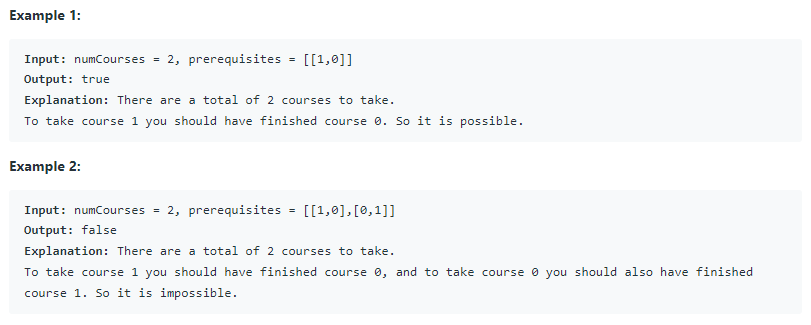
주어진 제한 조건은 1 ≤ numCourses ≤ 10^5, 0 ≤ prerequisites.length ≤ 5000, prerequisites[i].length = 2,
0 ≤ ai, bi < numCourses 과 prerequisites[i]은 서로 다른 순서쌍으로 이루어져 있다는 것이다.
< Course Schedule 문제 접근 >
vector나 2차원 vector로 강좌 간의 이수 관계를 나타내어보려 했으나 선이수 구조가 복잡해질 경우 이걸 하나하나 처리하기가 복잡해졌다. (↓실패한 코드, Cpp 사용)
#include <unordered_map>
#include <algorithm>
using namespace std;

void courseSearch(vector<vector<int>>& CourseGraph, int course, vector<int>& check){
    check[course] = 1;
    if(CourseGraph[course].empty()) return;
    while(!CourseGraph[course].empty()){
        courseSearch(CourseGraph, CourseGraph[course][0], check);
        CourseGraph[course].erase(CourseGraph[course].begin());
    }
}

bool canFinish(int numCourses, vector<vector<int>>& prerequisites) {
    unordered_map<int, bool> baseCase;
    for(int i=0;i<numCourses;i++)
        baseCase[i] = true;

    vector<vector<int>> CourseGraph(numCourses);
    for(vector<int> constraint : prerequisites){
        auto course = baseCase.find(constraint[1]);
        if(course != baseCase.end())
            baseCase.erase(course);

        auto checkpair = find(CourseGraph[constraint[1]].begin(), CourseGraph[constraint[1]].end(), constraint[0]);
        if(checkpair != CourseGraph[constraint[1]].end())
            CourseGraph[constraint[1]].erase(checkpair);
        CourseGraph[constraint[0]].push_back(constraint[1]);
    }

    vector<int> check(numCourses, 0);
    for(auto course : baseCase)
        courseSearch(CourseGraph, course.first, check);

    for(int i=0;i<numCourses;i++)
        if(!check[i]) return false;
    return true;
}
후이수강좌만을 CourseGraph에 저장해서 courseSearch를 해보면 될 것이라 생각했는데 선이수구조가 복잡한 경우(두 강좌 이상이 선이수강좌가 되는 경우) 탐색 및 선이수 처리를 이상하게 하며 오답을 출력하는 문제가 있었다.
그래서 정석적인 graph로 강좌 간 이수 관계를 나타내고자 하였다. 먼저 코드를 보면 다음과 같다. (Cpp 사용)
#include <algorithm>
using namespace std;

struct CourseNode{
    bool learned = false;
    vector<CourseNode*> parentNodes;
    vector<CourseNode*> childNodes;
}; // course 정보를 저장: 수강 여부, 선이수강좌, 후이수강좌

void courseSearch(CourseNode* Node){
    if(!Node->parentNodes.empty()) return; // 선이수강좌를 모두 들은 경우, 선이수강좌가 없는 경우
    Node->learned = true; // 수강 완료
    if(Node->childNodes.empty()) return; // 후이수강좌가 없는 경우 리턴
    for(CourseNode* childNode : Node->childNodes) // 후이수강좌에 대해 선이수 완료를 적용
        childNode->parentNodes.erase(find(childNode->parentNodes.begin(), childNode->parentNodes.end(), Node));
    while(!Node->childNodes.empty()){ // 후이수강좌에 대해 courseSearch 반복
        courseSearch(Node->childNodes.back());
        Node->childNodes.pop_back();
    }
}

bool canFinish(int numCourses, vector<vector<int>>& prerequisites) {
    CourseNode* CourseGraph = new struct CourseNode[numCourses]; // 직접 메모리 할당 필요
    for(vector<int> constraint : prerequisites){ // CourseGraph 작성
        (CourseGraph+constraint[0])->parentNodes.push_back(CourseGraph+constraint[1]);
        (CourseGraph+constraint[1])->childNodes.push_back(CourseGraph+constraint[0]);
    }

    for(int i=0;i<numCourses;i++)
        courseSearch(CourseGraph+i); // 수강가능 여부 탐색

    for(int i=0;i<numCourses;i++)
        if(!CourseGraph[i].learned) return false;
    return true;
}
CourseGraph를 나타내기 위해 CourseNode를 정의했다. course의 수강여부, 남은 선이수강좌, 남은 후이수강좌를 저장한다. 이 CourseNode의 집합이 CourseGraph이다.
courseSearch라는 함수를 통해 수강 여부 업데이트(by bool learned), 선이수완료 확인(if !Node→parentNodes.empty()), 후이수강좌에 대한 탐색의 재귀, 탐색의 종료(선이수 완료x, 후이수강좌x)를 구현하였다.
이렇게 모든 CourseNode에 대해 수강 가능 여부를 탐색한 후 하나라도 수강완료하지 못한 강좌가 있을 경우 false를 리턴하게 된다. 모두 수강 완료하였다면 true를 리턴한다.
Runtime: 32 ms(faster than 43.62%), Memory Usage: 15.5 MB(less than 14.59%)
'2022 Algorithm Study(by leetcode) > Graph' 카테고리의 다른 글
| [ leetcode 문제풀이 ] Number of Connected Components in an Undirected Graph (0) | 2022.02.27 |
|---|---|
| [ leetcode 문제풀이 ] Graph Valid Tree (0) | 2022.02.26 |
| [ leetcode 문제풀이 ] Number of Islands (0) | 2022.02.17 |
| [ leetcode 문제풀이 ] Longest Consecutive Sequence (0) | 2022.02.16 |
| [ leetcode 문제풀이 ] Pacific Atlantic Water Flow (0) | 2022.02.12 |


